Jump to main page text 

Concert Programme for the 2012-2013 season

[Hide programme details]
Sunday 28th October 2012 − 7.30pm West Road Concert Hall, Cambridge
Tchaikovsky and Whitacre
TCHAIKOVSKY: Romeo and Juliet
ERIC WHITACRE: Lux Aurumque
MORTEN LAURIDSEN: Mid-Winter Songs
TCHAIKOVSKY: Symphony No. 6
Conductor: Steve Bingham

The season starts with Tchaikovsky at his most impassioned and heartfelt. Whilst Romeo and Juliet was inspired by Shakespeare, the Pathétique was undoubtedly informed by his own inner turmoil and famously, the premiere took place but a few days before the composer’s untimely death.

The programme is completed with works by the two preeminent American choral composers of today. Eric Whitacre has taken the world by storm in recent years – indeed, John Rutter has described him as “one of the quintessential composers of the 21st century”. Celebrated at the 2012 Proms and currently Visiting Fellow at Sidney Sussex College, both he and fellow-Californian Morten Lauridsen write in an instantly captivating musical language: sumptuous, bitter-sweet and beguiling.

“I consider it the best and, in particular, the most sincere of all my works. I love it as I have never loved any other of my musical offspring.” Tchaikovsky on the Sixth Symphony


Related link: Programme (PDF 434 kB)
 
Sunday 9th December 2012 − 7.30pm West Road Concert Hall, Cambridge
Verdi: La Traviata
Concert performance sung in Italian with English supertitles.
VERDI: La Traviata
Conductor: Timothy Redmond
Soloists: Linda Richardson (Violetta Valéry), Jesús Leon (Alfredo Germont), Dean Robinson (Giorgio Germont), Elizabeth Powell (Flora Bervoix/Annina), Philip Sheffield (Gaston/Giuseppe), Nicholas Garrett (Doctor Grenvil), Leandros Taliotis (Baron Douphol), Joseph Padfield (Marchese d’Obigny)

La Traviata is arguably the best-loved and most performed of all Verdi’s operas. Containing some of the most famous choruses and arias ever composed, Traviata is as heartbreaking a tale of love lost and found as one could wish for. Dreaming of a better life, Violetta falls for Alfredo, but despite their happiness, social convention forces them to part. The pair are eventually reunited, but too late, as Violetta succumbs to consumption in the arms of her lover.

An all-star cast is led by Kathleen Ferrier Award-winning tenor Ben Johnson who first sang with the Cambridge Philharmonic in 2007. Now, just before he appears in the role for English National Opera, we welcome him back to perform Alfredo alongside Linda Richardson, currently singing Violetta for Scottish Opera and who was the unforgettable Mimí in our 2009 La Bohème.

“Linda Richardson … an outstanding Violetta.” Opera Magazine

“I adore art ... when I am alone with my notes, my heart pounds and the tears stream from my eyes, and my emotion and my joys are too much to bear.” Verdi


Related link: Programme (PDF 708 kB)
 
Saturday 19th January 2013 − 2pm and 4pm West Road Concert Hall, Cambridge
Family Concert
BRETT MCKENZIE: The Muppetts: Life’s a Happy Song
GRIEG: In the Hall of the Mountain King
TCHAIKOVSKY: Swan Lake Suite (No. 6)
MATTHEW HINDSON: Headbanger
ROSSINI: William Tell: Galop
WILLIAMS: Hook: Flight to Neverland
MAHLER: 4th Symphony: Extract
Conductor: Timothy Redmond

Everything is great, everything is grand,
I’ve got the whole wide world in the palm of my hand!
Life’s a happy song when there’s someone by your side to sing along!

But what happens when you lose something very important?

Join the Cambridge Phil and Tom Redmond, who presents concerts for the Hallé Orchestra and BBC Radio 3, on a musical journey that will take you out of this world. You’ll be able to sing along, join in and help the orchestra choose where they go next on their hunt for the conductor’s missing baton!


Related link: Programme (PDF 334 kB)
 
Sunday 10th March 2013 − 7.30pm West Road Concert Hall, Cambridge
Spring Symphony
Joint concert with the Fairhaven Singers, and choirs from St Mary’s School and The Stephen Perse Foundation
POULENC: Gloria
BRITTEN: Spring Symphony
Conductor: Ralph Woodward
Soloists: Emily Rowley Jones (Soprano), Bridget Hardy (Alto), Julian Forbes (Tenor)

Britten’s Spring Symphony was commissioned by the Koussevitzky Foundation and was first performed at the Concertgebouw in Amsterdam in 1949. In the composer’s words, it is “a symphony not only dealing with the Spring itself but with the progress of Winter to Spring and the reawakening of the earth and life which that means”. Part song-cycle, part symphony and part oratorio, it is a virtuoso work for large forces (the huge orchestra even includes a cow horn!) and provides the perfect showcase for some of Cambridge’s leading musical organisations.

To start the concert, the Fairhaven Singers and the Cambridge Philharmonic Orchestra perform Poulenc’s joyous and exuberant Gloria (1961), another work that owes its existence to the enlightened and generous Koussevitzky Foundation.

“While writing [the Gloria] I had in mind those Gozzoli frescoes with angels sticking out their tongues, and also some solemnlooking Benedictine monks that I saw playing football one day.” Francis Poulenc


Saturday 20th April 2013 − 8pm King’s College Chapel, Cambridge
Elgar: The Kingdom
ELGAR: The Kingdom
Conductor: Timothy Redmond
Soloists: Yvonne Howard (Soprano), Heather Shipp (Mezzo soprano), Nicky Spence (Tenor), Dean Robinson (Bass)

Following the success of The Dream of Gerontius, Elgar planned a grand triptych of choral works to chart the very foundation and purpose of the church. He began with The Apostles (1903) and intended to finish with The Last Judgement, but the composer’s attentions were increasingly drawn to symphonic writing, and so the trilogy was left incomplete and The Kingdom (1906) remains his last full-length oratorio.

Praised recently in the Daily Telegraph as having “a voice of real distinction”, fast-rising star Nicky Spence returns to the Cambridge Philharmonic as part of a distinguished quartet of soloists for this glorious work.

“There is music in the air, music all around us, the world is full of it and you simply take as much as you require.” Sir Edward Elgar


Related links: Programme (PDF 1 MB); Review (Cambridge News)
 
Saturday 25th May 2013 − 7.30pm West Road Concert Hall, Cambridge
MOZART: Piano Concerto in D Minor K.466 − Soloist: Martin Roscoe
MAHLER: Symphony No. 4 − Soloist: Heather Shipp

Martin Roscoe is one of this country’s finest musicians. In this, his 60th birthday season, he joins the Cambridge Philharmonic directly after appearances with the Hallé, BBC Philharmonic and Royal Philharmonic Orchestras. He plays Mozart’s turbulent D minor concerto – a work composed in such a hurry that the parts were still being copied on the day of the premiere! It was an immediate success and it wasn’t long before the young Beethoven had it in his repertoire.

If, as Mahler famously said, a symphony “should encompass the world”, then of all his works, it is the sunny and uplifting Fourth Symphony that describes a world Mozart and Beethoven might well have recognised. Bells jingle, birds sing and in the last movement we hear a child’s magical vision of heaven.

“If a composer could say what he had to say in words he would not bother trying to say it in music.” Gustav Mahler

“…Roscoe is a pianist who both thinks and offers full-blooded playing of breadth and depth. In this country, he is an uncommon creature…” Daily Telegraph


Related links: Poster (PDF 123 kB); Programme (PDF 896 kB)
 
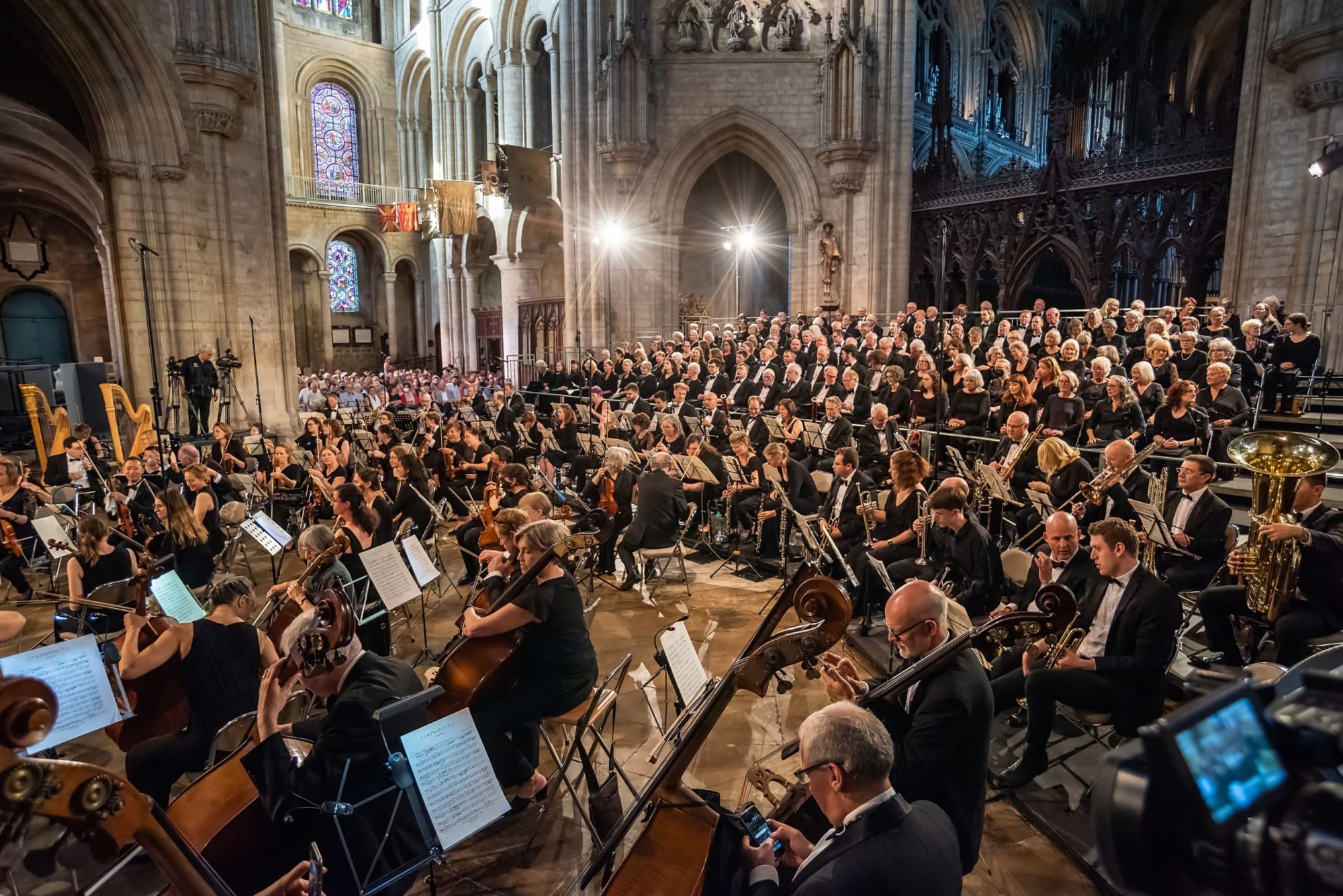
Saturday 13th July 2013 − 7.30pm Ely Cathedral
DOVE: A Song of Joys
BRITTEN: Ballad of Heroes
TIPPETT: A Child of Our Time
Soloists: Gweneth-Ann Jeffers (Soprano), Yvonne Howard (Mezzo soprano), Daniel Norman (Tenor), Nicholas Garrett (Baritone)

The season comes to a close in the magnificent setting of Ely Cathedral with three British works that span seven decades. Jonathan Dove’s sparkling setting of Walt Whitman’s words was commissioned to open the Last Night of the 2010 Proms and was subsequently used as the theme for the 2012 Proms broadcasts. In 1939, the 26-yearold Britten used text by WH Auden for his Ballad of Heroes, written in honour of the fallen of the Spanish Civil War.

Tippett’s magnum opus was written in direct response to the chilling events of Kristallnacht. Composed between 1939 and 1941, A Child of Our Time has lost none of its impact; its message of compassion and its universality have ensured it has retained its place in the repertoire.

“When I wrote the work, I was so engulfed in the actions of the period, I never considered its prophetic quality. But it seems that the growing violence springing out of divisions of nation, race, religion, status, colour, or even just rich and poor is possibly the deepest present threat to the social fabric of all human society.” Tippett in 1980 on A Child of Our Time


Friday 11th January 2013
Family Concert
Details of this concert are unconfirmed